
- -85%
 Security policy
(edit with the Customer Reassurance module)
 Delivery policy
(edit with the Customer Reassurance module)
 Return policy
(edit with the Customer Reassurance module)
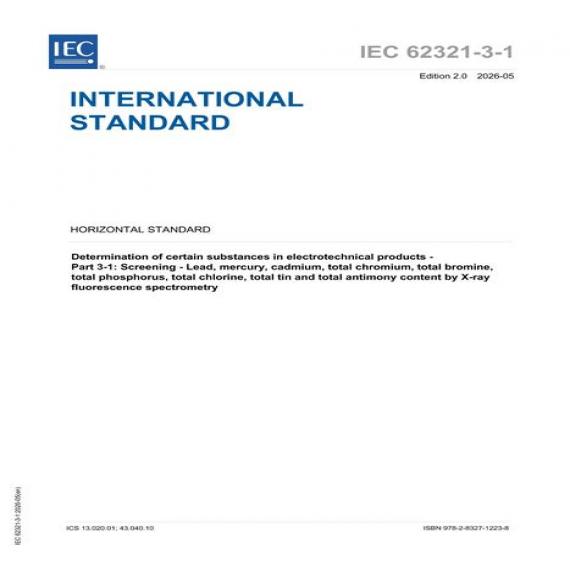
IEC 62321-3-1:2026 Describes the screening analysis of substances, specifically lead (Pb),
mercury (Hg), cadmium (Cd), total chromium (Cr), total bromine (Br), total phosphorus (P),
assuming the source of P is related to TCEP (CAS 115-96-8), Trixylyl‑phosphate
(CAS 25155-23-1), total chlorine (Cl), assuming the source of Cl is related to SCCP
(CAS 85535-84-8), TCEP (CAS 115-96-8) , TBTC (CAS 1461-22-9), total tin (Sn), assuming the
source of Sn is related to restricted organo‑tin compounds, total antimony (Sb), assuming the
source of Sb is related to Pyrochlore, and antimony lead yellow (CAS 8012-00-8) in uniform
materials found in electrotechnical products, using the analytical technique of X‑ray
fluorescence (XRF) spectrometry.
The same methodology can also be used for screening of substances discussed as critical raw
materials in various countries (for example currently discussed in the EU: antimony (Sb), baryte,
bismuth (Bi), cobalt (Co), fluorspar, gallium (Ga), germanium (Ge), hafnium (Hf), indium (In),
magnesium (Mg), niobium (Nb), phosphorus (P), scandium (Sc), tantalum (Ta), tungsten (W),
vanadium (V), platinum group metals, heavy rare earth elements, light rare earth elements).
NOTE From EU information on critical raw materials [1]1 raw materials are crucial to Europe's economy. They form
a strong industrial base, producing a broad range of goods and applications used in everyday life and modern
technologies. Reliable and unhindered access to certain raw materials is a growing concern within the EU and across
the globe. To address this challenge, the European Commission has created a list of critical raw materials (CRMs)
for the EU, which is subject to a regular review and update. CRMs combine raw materials of high importance to the
EU economy and of high risk associated with their supply.
The method is applicable to plastics, metals and ceramic materials. The test method can be
applied to raw materials, individual materials taken from products and "homogenized" mixtures
of more than one material. Screening of a sample is performed using any type of XRF
spectrometer, provided it has the performance characteristics specified in this test method. Not
all types of XRF spectrometers are suitable for all sizes and shapes of sample. The appropriate
spectrometer design will be selected with care for the task concerned.
The performance of this test method has been tested for the following substances in various
media and within the concentration ranges as specified in Table 1 to Table 5. During an IIS
(international interlaboratory study) the feasibility of the test method to use for the added
elements was tested. The results are listed in Table 6 to Table 10.
These substances in similar media outside of the specified concentration ranges can be
analysed according to this test method; however, the performance has not been established for
this document.
WARNING – Persons using this International Standard should be familiar with normal
laboratory practice. This standard does not purport to address all of the safety problems,
if any, associated with its use. It is the responsibility of the user to establish appropriate
safety and health practices and to ensure compliance with any national regulatory
conditions.
This document is a basic environment horizontal publication focusing on test methods and is
primarily intended for use by committees in the preparation of publications within the area of
environment in accordance with the principles laid down in IEC Guide 123. Wherever applicable,
it is the responsibility of committees to make use of environment basic publications in the
preparation of their environment group and product publications. Committees can apply this
document directly to products when they do not develop a product publication in the area of
environment.