
- -85%
 Security policy
(edit with the Customer Reassurance module)
 Delivery policy
(edit with the Customer Reassurance module)
 Return policy
(edit with the Customer Reassurance module)
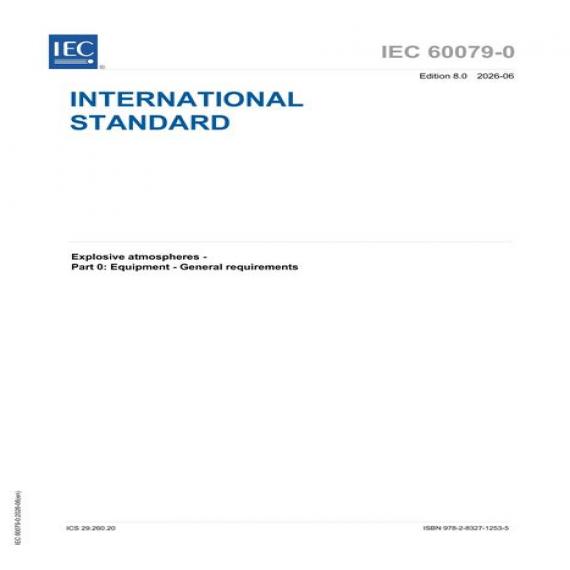
This part of IEC 60079 specifies the general requirements for construction, testing and marking
of Ex Equipment and Ex Components intended for use in or associated with explosive
atmospheres.
The standard atmospheric conditions (relating to the explosion characteristics of the
atmosphere) for Ex Equipment are:
– temperature −20 °C to +60 °C;
– pressure 80 kPa (0,8 bar) to 110 kPa (1,1 bar); and
– air with normal oxygen content, typically a volume fraction of 21 %.
This part of IEC 60079 and other documents supplementing this document specify additional
test requirements for Ex Equipment operating outside the standard temperature range, but in
some cases, further additional consideration and additional testing is required for Ex Equipment
operating outside the standard atmospheric pressure range and standard oxygen content. Such
additional testing is particularly relevant with respect to Types of Protection that depend on
quenching of a flame such as 'flameproof enclosures "d"' (IEC 60079-1) or limitation of energy,
'intrinsic safety "i"' (IEC 60079-11).
NOTE 1 Although the standard atmospheric conditions above give a temperature range for the atmosphere of
−20 °C to +60 °C, the normal ambient temperature range for the Ex Equipment is −20 °C to +40 °C, unless otherwise
specified and marked. See 5.1.1. It is considered that −20 °C to +40 °C is appropriate for many items of Ex Equipment
and that to manufacture all Ex Equipment to be suitable for a standard atmosphere upper ambient temperature of
+60 °C would place unnecessary design constraints.
NOTE 2 Requirements given in this document result from an ignition hazard assessment made on equipment. The
ignition sources taken into account are those found associated with this type of equipment, such as hot surfaces,
electromagnetic radiation, mechanically generated sparks, mechanical impacts resulting in thermite reactions,
electrical arcing and static electric discharge in normal industrial environments.
NOTE 3 Where an explosive gas atmosphere and a combustible dust atmosphere are, or can be, present at the
same time, the simultaneous presence of both often warrants additional protective measures. Additional guidance
on the use of Ex Equipment in hybrid mixtures (mixture of a flammable gas or vapour with a combustible dust or
combustible flyings) is given in IEC 60079-14.
NOTE 4 Any short-term thermal excursions that occur as a result of electrical current excursions above normal
rated currents, such as those that occur during the starting of motors, are not considered to create a significant
possibility of ignition of an explosive atmosphere due to the relatively short duration of the event and the convection
that occurs during the event.
IEC 60079 does not specify requirements for safety, other than those directly related to the
reduction (mitigation) of ignition hazards.
Ignition sources like adiabatic compression, shock waves, exothermic chemical reaction, selfignition
of dust, naked flames and hot gases/liquids, are not addressed by this document.
NOTE 5 Although outside the scope of this document, such equipment would typically be subjected to an ignition
hazard assessment that identifies and lists all of the potential sources of ignition by the equipment and the measures
to be applied to prevent them becoming effective. See ISO 80079-36.
This document is supplemented or modified by the following parts of the IEC 60079 and
ISO/IEC 80079 series:
– IEC 60079-1: Gas - Flameproof enclosures "d"
– IEC 60079-2: Gas and dust - Pressurized enclosure "p"
– IEC 60079-5: Gas - Powder filling "q"
– IEC 60079-6: Gas - Liquid immersion "o"
– IEC 60079-7: Gas - Increased safety "e"
– IEC 60079-11: Gas and dust - Intrinsic safety "i"
– IEC 60079-13: Gas and dust - Equipment protection by pressurized room "p" artificially
ventilated room "v"
– IEC 60079-15: Gas - Type of protection "n"
– IEC 60079-18: Gas and dust - Encapsulation "m"
– IEC 60079-25: Gas and dust - Intrinsically safe electrical systems
– IEC 60079-26: Gas and dust - Equipment with Separation Elements or combined Levels of
Protection
– IEC 60079-28: Gas and dust - Protection of equipment and transmission systems using
optical radiation
– IEC 60079-29-0: Gas - Gas detection equipment - General requirements and test methods
– IEC 60079-29-1: Gas detectors - Performance requirements of detectors for flammable
gases
– IEC 60079-29-4: Gas detectors - Performance requirements of open path detectors for
flammable gases
– IEC/IEEE 60079-30-1: Gas and dust - Electrical resistance trace heating - General and
testing requirements
– IEC 60079-31: Dust - Protection by enclosure "t"
– IEC 60079-33: Gas and dust - Special protection "s"
– IEC 60079-35-1: Caplights for use in mines susceptible to firedamp - General requirements
- Construction and testing in relation to the risk of explosion
– IEC TS 60079-39: Gas - Intrinsically safe systems with electronically controlled spark
duration limitation
– IEC TS 60079-40: Gas - Requirements for process sealing between flammable process
fluids and electrical systems
– IEC TS 60079-46: Gas and dust - Equipment assemblies
– IEC TS 60079-47: Gas and dust - Equipment protection by 2-wire intrinsically safe Ethernet
concept (2-WISE)
– IEC 62784: Dust - Vacuum cleaners and dust extractors providing EPL Dc
– ISO 80079-36: Gas and dust - Non-electrical equipment for explosive atmospheres - Basic
method and requirements
– ISO 80079-37: Gas and dust - Non-electrical equipment for explosive atmospheres - Non
electrical Type of Protection constructional safety "c", control of ignition source "b", liquid
immersion "k"
This document, along with the additional parts of IEC 60079 and ISO/IEC 80079 mentioned
above, is not applicable to the construction of
– electromedical apparatus,
– shot-firing exploders,
– test devices for exploders, and
– shot-firing circuits.